
Unit 27/35 Lusher Road
Croydon South VIC 3136
03 97616659
Call us today
Mon - Fri: 8AM - 4PM
We are open
Croydon South VIC 3136
Call us today
We are open
Custom Cable Assemblies · Melbourne, Australia
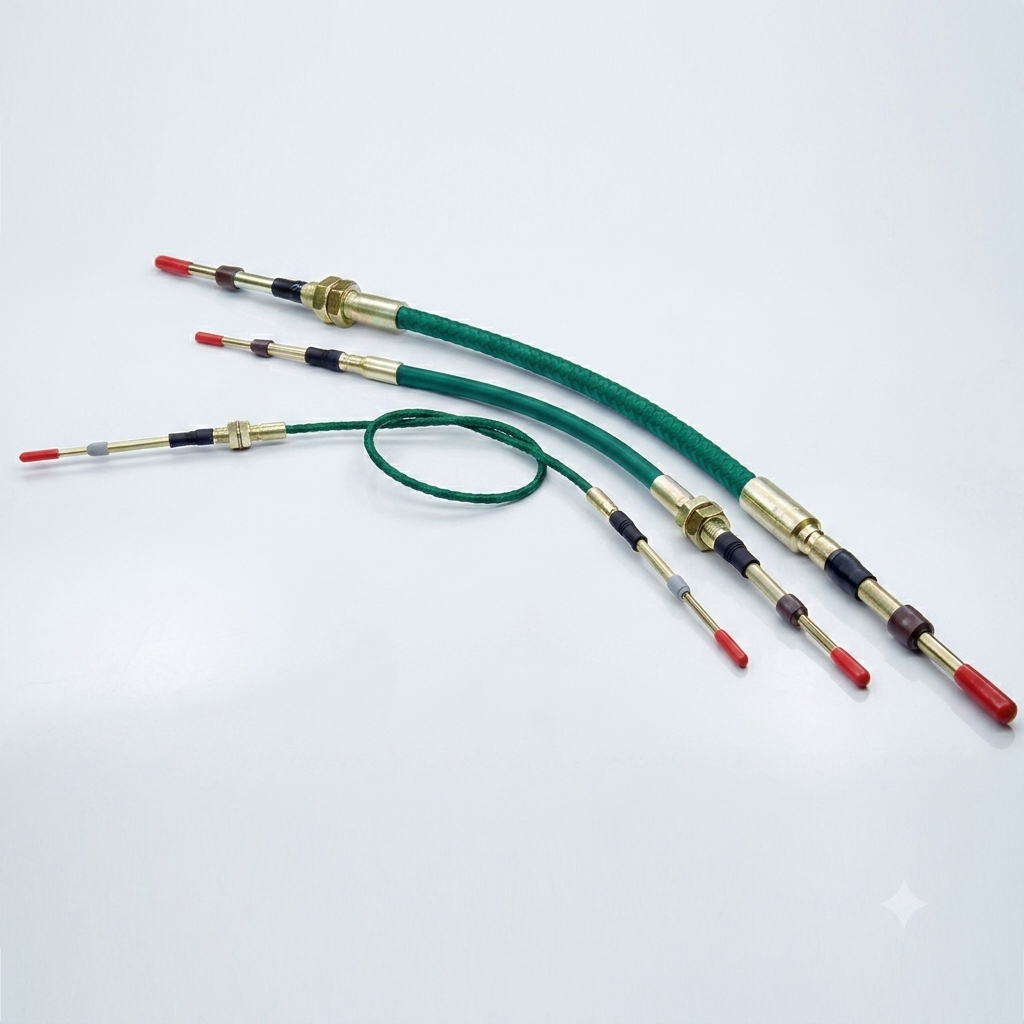
A push pull cable is a mechanical control cable that transmits both pushing and pulling force along a single line, letting you operate a control remotely and around bends. TGA Cables manufactures custom push pull cables in Melbourne, Australia, built to any stroke, load rating, end-fitting and mounting configuration, with a tighter bend radius than standard assemblies. With 26+ years of experience and Australia-wide supply, we build the exact cable your application needs.
What / How
A push pull cable is a mechanical control cable that transmits both pushing and pulling force along a single line, letting you operate a control remotely and around bends.
Inside a push pull cable, a stiff inner core (a 1×19 swaged steel strand) slides through a low-friction, PTFE-lined outer conduit. Push or pull the core at the input end and it transmits that linear motion to the output end with minimal lost travel, so a single cable can both push and pull a load, even when routed around corners where a solid rod could never fit. That makes push pull cables ideal for gear-shift, throttle, brake, valve and remote-actuation controls.
New to push pull cables? Start with the basics of push-pull cables, or read our comprehensive guide to push-pull cable systems for a deeper look at construction, materials and applications. If your control only needs to move in one direction, see our control cables and pull-only cables ranges.
Need a cable built to spec?
Send your specs or a photo of the old cable and our Melbourne workshop will match it exactly.
Real Data
Every cable is made to order. Our industrial push-pull controls (CableCraft / Tuthill Push-Pull Standard) are built to the following specifications:
| Parameter | Options / range |
|---|---|
|
Construction types |
Bristow, Utility, Low Friction EXT and Low Friction — chosen to suit bend radius, efficiency, temperature and budget |
|
Working push-pull load |
Very Light Duty (~120 lb / 0.5 kN) through to Heavy Duty (up to 1,000 lb / 4.4 kN); overload capacity to 1,500 lb (6.7 kN) |
|
Stroke / travel |
1″ to 6″ standard (25–150 mm); custom travel available |
|
Overall length |
Custom — any length to suit the installation |
|
Temperature range |
−54 °C to +110 °C standard; Low Friction (PTFE) rated to +154 °C (−65 °F to +310 °F) |
|
End-rod threads |
10-32, 1/4-28, 5/16-24 and 3/8-24 UNF |
|
End-fittings |
Threaded or grooved swivel (GG / TG / TT), plus clevises, eye ends, ball joints and rod ends |
|
Inner member |
1×19 swaged steel strand; stainless-steel option; PTFE-coated on Low Friction for smooth, stick-slip-free operation |
|
Materials |
Type 300 stainless steel or plated carbon steel end rods and support tubes |
|
Seals |
Model 5 floating wiper seal standard; Model 6 for extreme/contaminated environments |
|
Bend radius |
Tighter minimum bend radius than standard assemblies (Utility and Low Friction constructions) |
|
Environment |
Corrosion- and abrasion-resistant plastic-cased conduit for harsh, outdoor and marine use |
Need a specific part number matched? Send your CableCraft ordering code or a competitor part number and we will build or cross-reference it.
Build Options
Choosing the right construction balances bend radius, efficiency, temperature and cost:
1. Bristow
an economical construction for applications that do not require tight bend radii; rated to +110 °C.
2. Utility
adds a binder wire for structural integrity and a tighter minimum bend radius than Bristow.
3. Low Friction EXT
Utility advantages plus a plastic-covered inner member for improved efficiency.
4. Low Friction
the standard of excellence: binder wire, tight minimum bend radius and a PTFE-covered inner member for the smoothest operation and long life, rated to +154 °C.
Not sure which construction you need? Tell us the application and we will specify it- call 03 9761 6659.
Selection Guide
To specify a push pull cable, work through these six factors, or simply send us the old cable or a photo and we will do it for you:
Stroke / travel
how far the control must move at each end (1″–6″ standard). This sets the internal travel of the cable.
Overall length
the end-to-end routed length from input to output, following the real path (not a straight line).
Load / duty rating
the push and pull force required, which sets the duty class (Very Light through Heavy Duty).
End-fittings & threads
the connector and thread at each end (threaded or grooved swivel; 10-32 to 3/8-24 UNF) so it bolts straight to your control and load.
Bend radius & routing
the tightest bend the cable must follow. Tighter bends need a Utility or Low Friction construction; this is where our tight-bend-radius capability matters.
Environment & temperature
heat, cold, moisture, corrosion or chemical exposure, which determines construction, materials and seal choice.
Not sure of a value? Our team will help you specify it correctly- call 03 9761 6659 and talk to a cable specialist.
Industries
Trucks & heavy vehicles
throttle, transmission shift, gear-shift and clutch controls
Mining, construction & agriculture
implement control, PTO/4WD activation, hydrostatic drives
Industrial machinery & OEMs
valve actuation, remote battery/electrical disconnects, latches
Marine
throttle, shift and steering controls
Automotive & motorsport
custom and replacement control cables
Industrial Control, Cable Assembly
Tuthill Controls offers a full range of push-pull controls that provide a means of transmitting linear motion from one location to another. They offer ease of installation as well as superior performance.

Answers
A push pull cable is a mechanical control cable that transmits both pushing and pulling force along the same line, so movement at one end produces the same movement at the other. An inner core slides inside a rigid outer conduit, letting you operate a control remotely and around bends where a solid rod cannot reach.
A stiff inner core runs through a low-friction, PTFE-lined conduit. When you push or pull the core at the input end, it transmits that linear motion to the output end with minimal lost travel, so it can both push and pull a load. The conduit holds the core in compression so force is not lost, even around corners.
Throttle and implement controls, transmission and gear shift, PTO and 4WD activation, valve actuation, hydrostatic drives, remote battery or electrical disconnects, latches and dead-man switches, across trucks, heavy vehicles, mining, construction and agricultural equipment, industrial machinery, marine craft and automotive applications.
It depends on the construction. We build push pull cables from very-light-duty up to heavy-duty, with working push-pull loads from around 120 lb (0.5 kN) to 1,000 lb (4.4 kN) and overload capacity up to 1,500 lb (6.7 kN) in heavy-duty construction. We match the duty rating to your application.
Standard constructions are rated from about −54 °C to +110 °C (−65 °F to +230 °F). Our Low Friction, PTFE-lined construction is rated up to +154 °C (+310 °F) for demanding, high-temperature applications.
Record the overall length (end to end), the stroke or travel (typically 1″–6″), the end-fitting type and thread at each end, and the mounting configuration. The easiest and most accurate method is to send us the old cable or a clear photo of it and the installation area, and we will match every dimension and fitting.
Most push pull cables adjust at a threaded end-fitting or adjuster barrel near the mount: loosen the locknut, turn the adjuster to set correct free play or travel, then re-tighten. Fit mechanical stops at or below the rated travel so the end rod never bottoms inside the conduit cap. No adjuster? We can build a replacement with one.
Yes, it is our specialty. We build to your exact stroke, length, load rating, end-fittings and mounting, including one-off, low-volume, discontinued and improved-spec assemblies, with a tighter bend radius than standard cables.
A worn, seized or snapped cable is usually best replaced with a like-for-like or improved custom build rather than patched. Send us the old cable or a photo and we will manufacture an exact replacement to spec.
A push pull cable transmits force in both directions; a pull-only cable pulls in one direction and relies on a spring or gravity to return. Choose push pull where the control must actuate both ways, such as throttle or gear-shift systems. See our pull-only cables
TGA Cables manufactures custom push pull cables in Melbourne, with 26+ years of experience and Australia-wide supply. We are the sole Victorian distributor of CableCraft Motion Controls (Tuthill Controls Group) and build to any specification. Send a photo or your specs for a fast quote.
Get Started
Custom-built in Melbourne, shipped Australia-wide.
Mon–Fri, 8am–4pm
Request a quote